Ancient cylinder seals and more
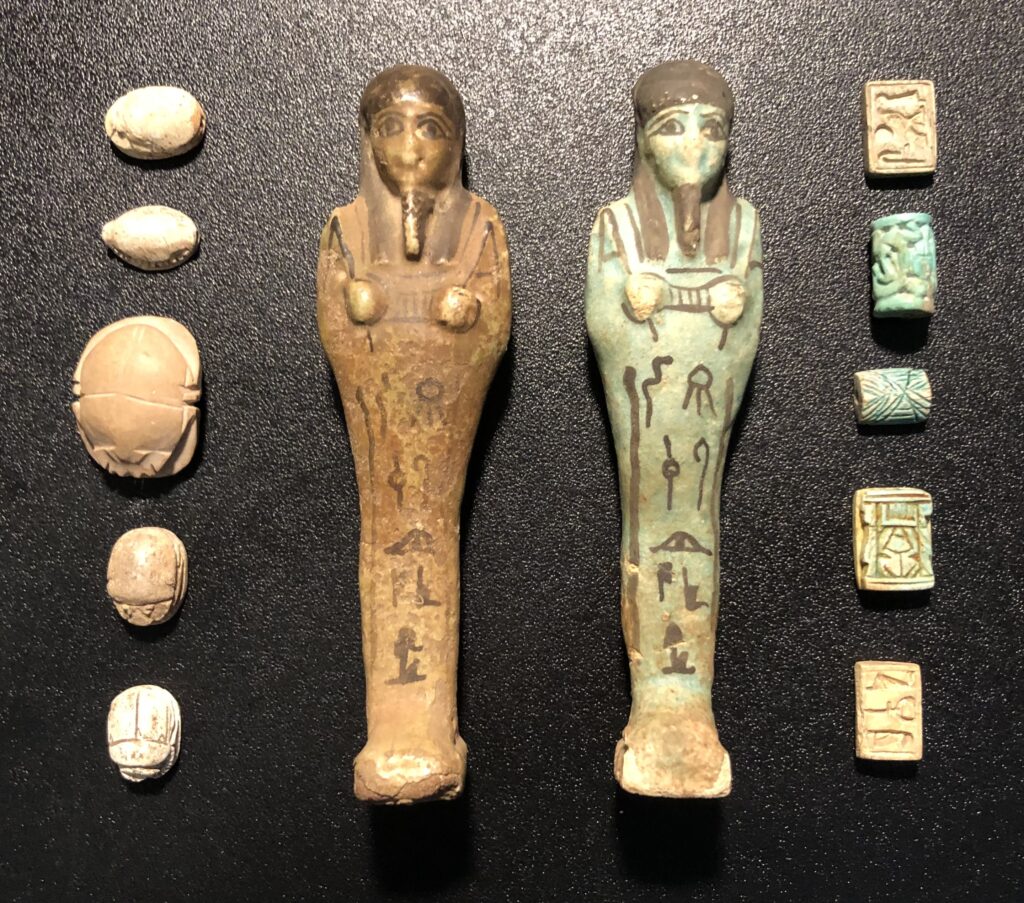
Egyptian seals and artifacts represent somewhat of a deviation from the central focus of the Van Egmond collection, but they do represent an important body of glyptic art that developed over a similar timeline as those Near Eastern pieces shown in this catalog. The select group of pieces featured here are intended to provide a small window into this vast realm of collecting and scholarship. They are intended to highlight the many variations in imagery, scripts, materials and use of seals across ancient cultures.
“Sealing technology first appears in Egypt around 3600 BCE during the Naqada II period of the Predynastic. Thereafter, the use of seals undergoes a lengthy evolution, responding to the shifting structure of the country’s political system, as well as changes in cultural, religious, and artistic traditions that spanned some three millennia.” i
“Uses of seals in ancient Egypt were various and diverse but as in other civilizations, marking for proving ownership or security were common.
“The Egyptians did not have locks and keys. Instead, they would secure a chest or other container with a piece of knotted cord. A lump of clay was put over the knot and a seal was pressed into the clay. The cord would have to be cut, or the seal broken in order to open the container and remove the contents.” ii
Scarabs were certainly used as charms or amulets, worn as personal decorations and jewelry but the vast quantity of impressions that have survived indicate that their primary ongoing purpose was for making impressions to sign, seal or otherwise identify an action of the seal’s holder.
For ancient Egyptians, vast numbers of seals and amulets in the form of the scarab have survived. “The Egyptian Scarabs were, for their ancient possessors, mainly amulets with powerful images or spells. To the moderns, the Scarab seals are objects of interest, either as emblems of Egyptian religion or specimens of the Egyptian art, while to the archaeologist and historian they are often useful as valuable evidences of the past.” iii
“The Egyptians saw the Egyptian scarab (Scarabaeus sacer) as a symbol of renewal and rebirth. The beetle was associated closely with the sun god because scarabs roll large balls of dung in which to lay their eggs, a behavior that the Egyptians thought resembled the progression of the sun through the sky from east to west. Its young were hatched from this ball, and this event was seen as an act of spontaneous self-creation, giving the beetle an even stronger association with the sun god’s creative force. The connection between the beetle and the sun was so close that the young sun god was thought to be reborn in the form of a winged scarab beetle every morning at sunrise. As this young sun god, known as Khepri, rose in the sky, he brought light and life to the land.” ii
The scarab had great significance in life and especially in a funerary context. “Since the sun was believed to die each night and reborn each morning as a beetle, the scarab took on significant regenerative powers. The deceased needed to harness these powers to be reborn in the afterlife – in the same way, the sun was reborn each morning.” iv
Seals and inscribed amulets in other forms exist but in smaller numbers. The collection includes a number of such seals in plaque, rectangle and other forms.
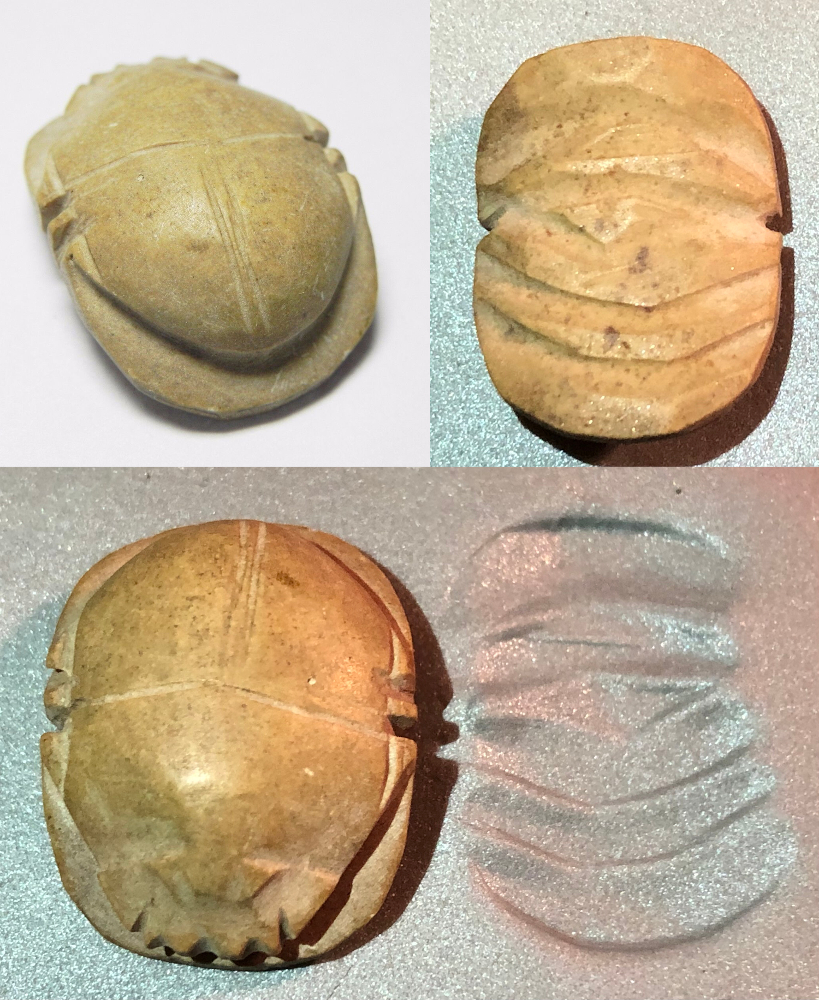
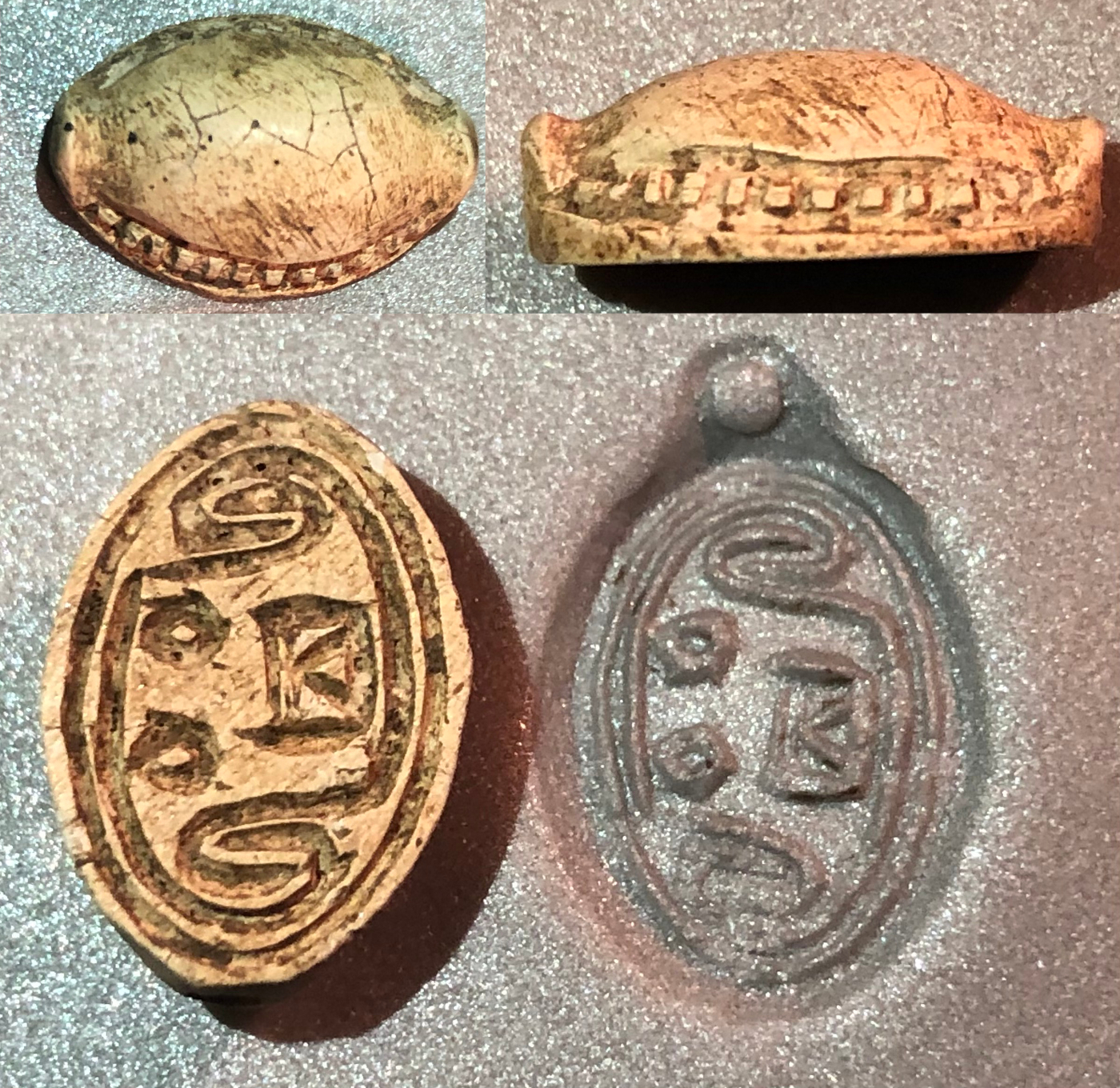
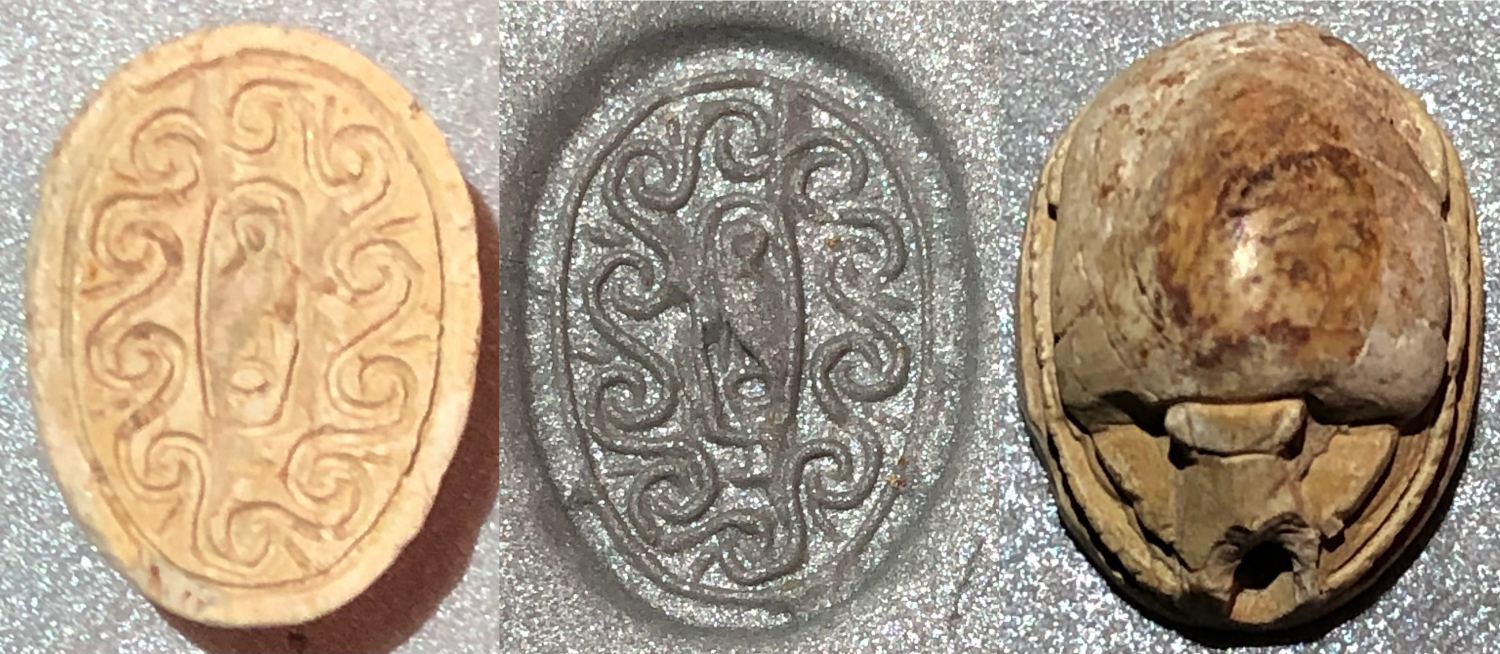
Ancient Lower Egyptian New Kingdom Period, 1550-1050 BC, white steatite stone scarab in the form of a cowroid with deeply carved geometric designs of a rectangle, chevron and two circles within a dual lined border. This piece has a bidirectional drill hole through the long axis and measures 16 x 11 x 6 mm.
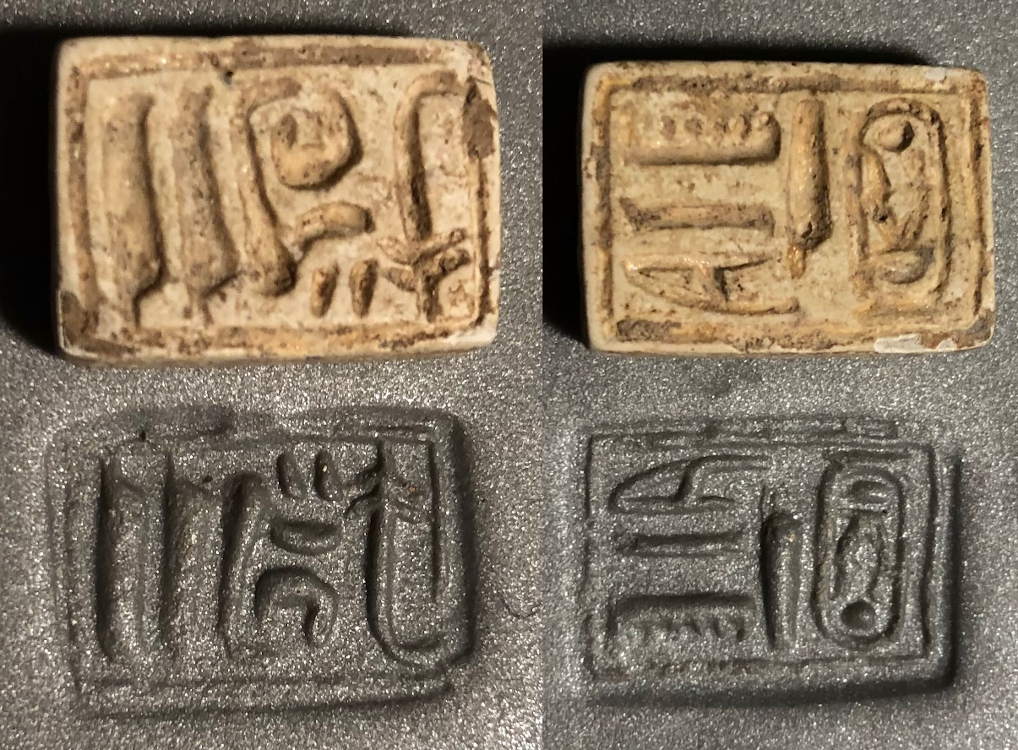
Ancient Egypt, New Kingdom Period 1550–1050 BC, white steatite plaque of two sides with a central bidirectional piercing for suspension. Face of side A: A:Ma’ At ma’ At (—). snow (Eternal truth — Pharoah). Face B: Amun and cartouche (us’r ma’ At r’ Rameses II). This item measures 13 x 19 mm.
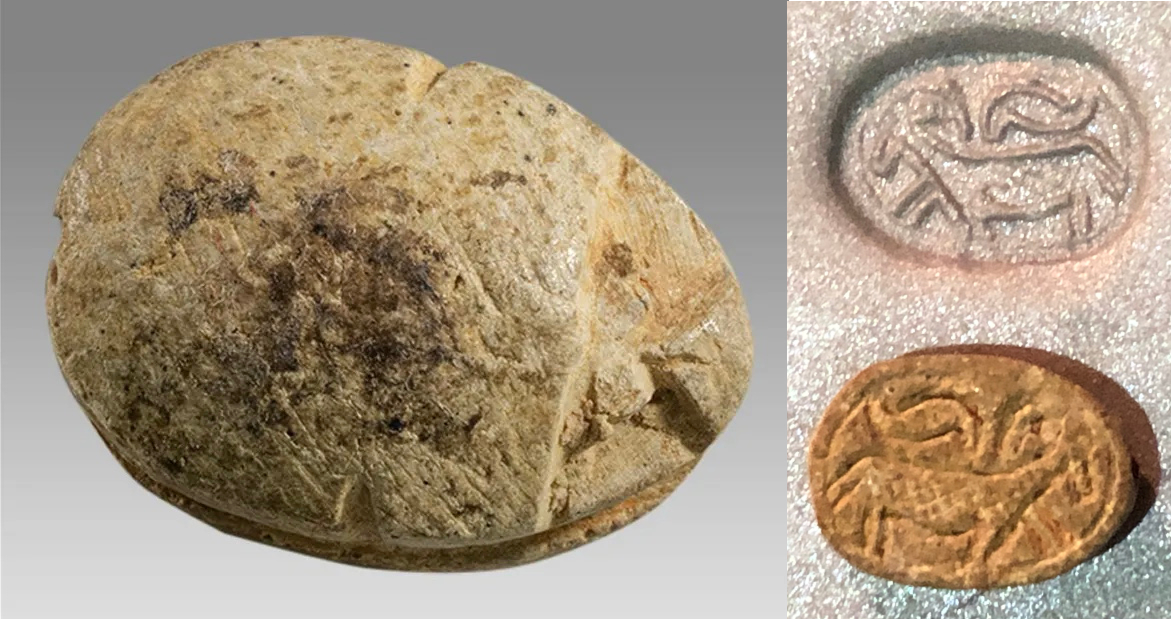
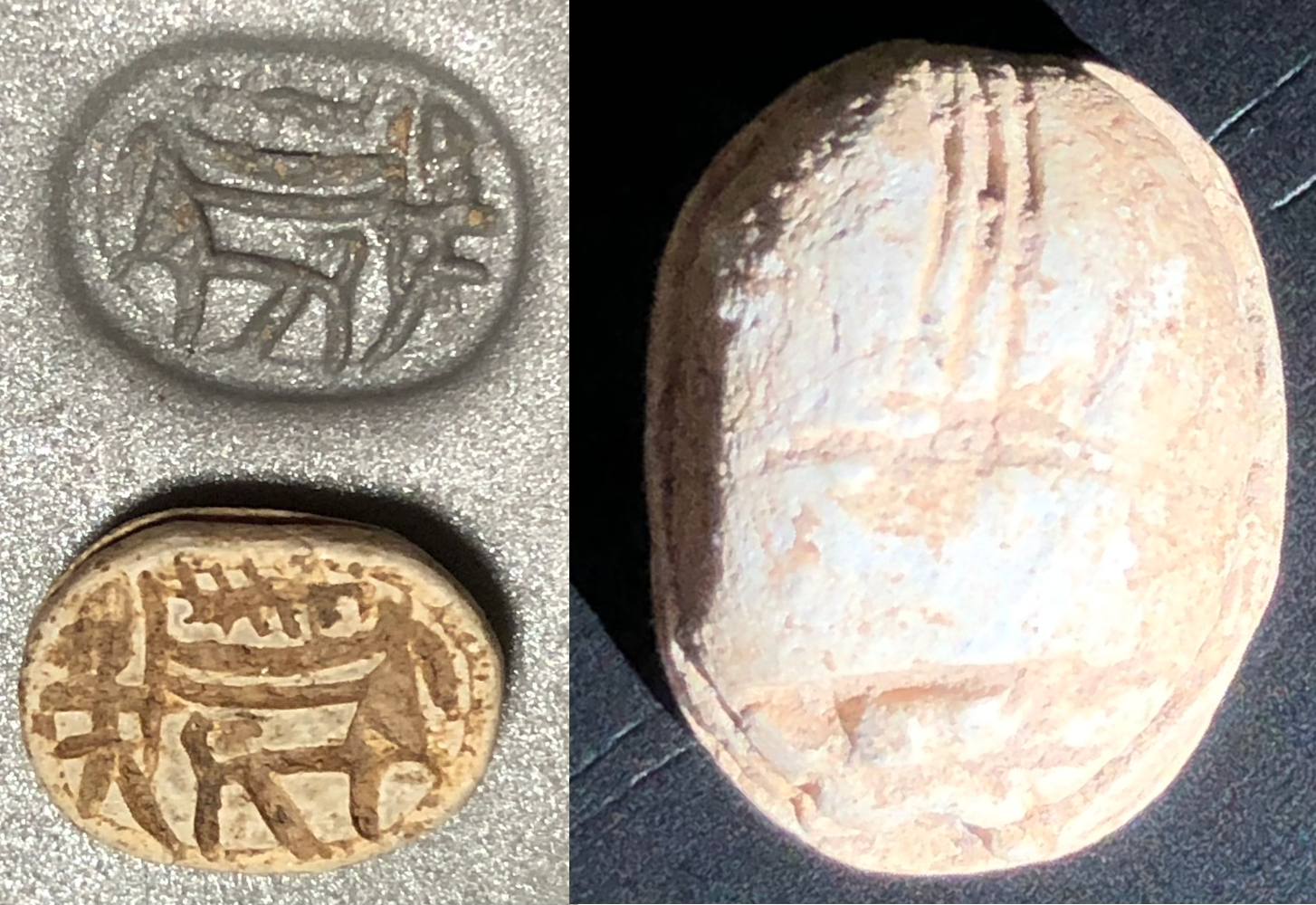
Ancient Egypt, white steatite scarab from the New Kingdom period, 1550-1050 BC. With a central bidirectional piercing through the long axis for suspension. The back shows basic engraving of features of a pastoral scene with a man to the left, a quadruped to the right, facing right with plants above. This piece measures 16 mm across at the widest point.
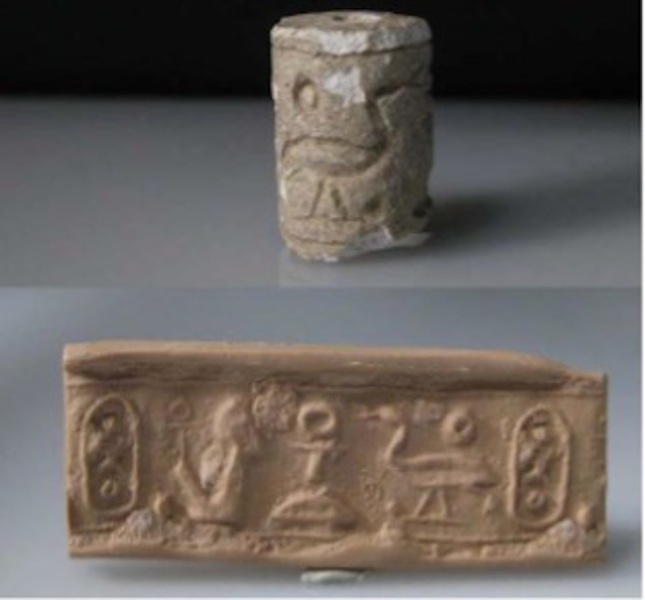
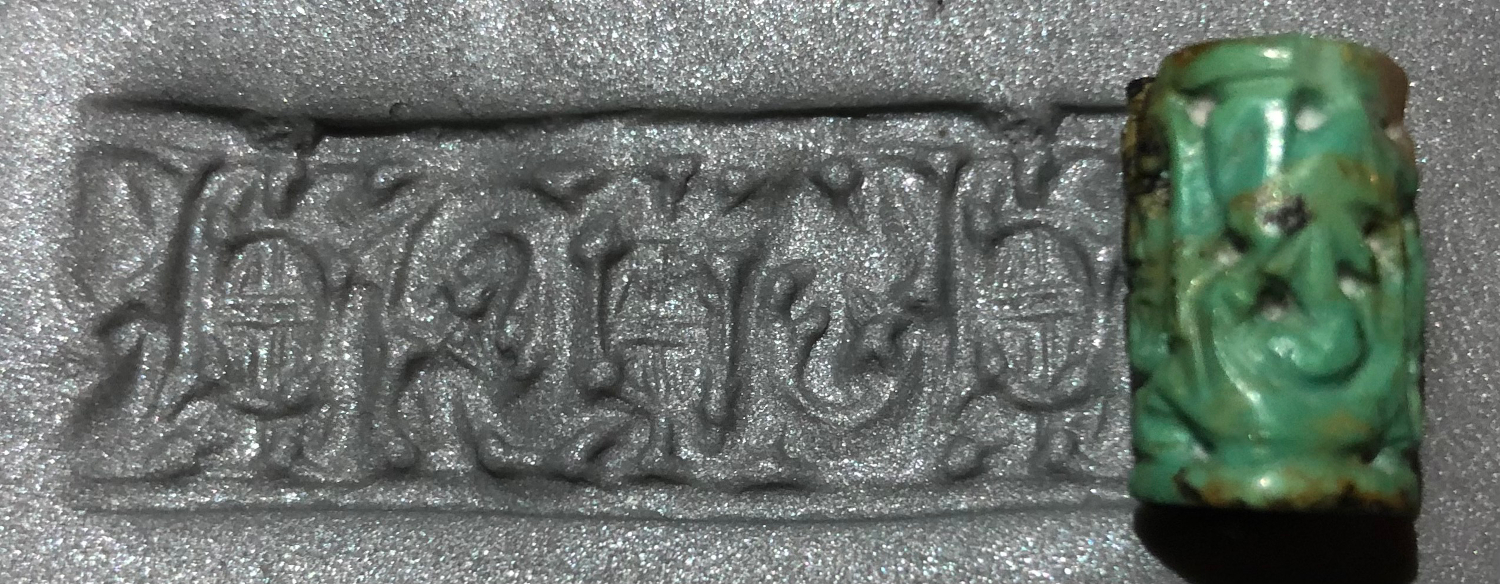
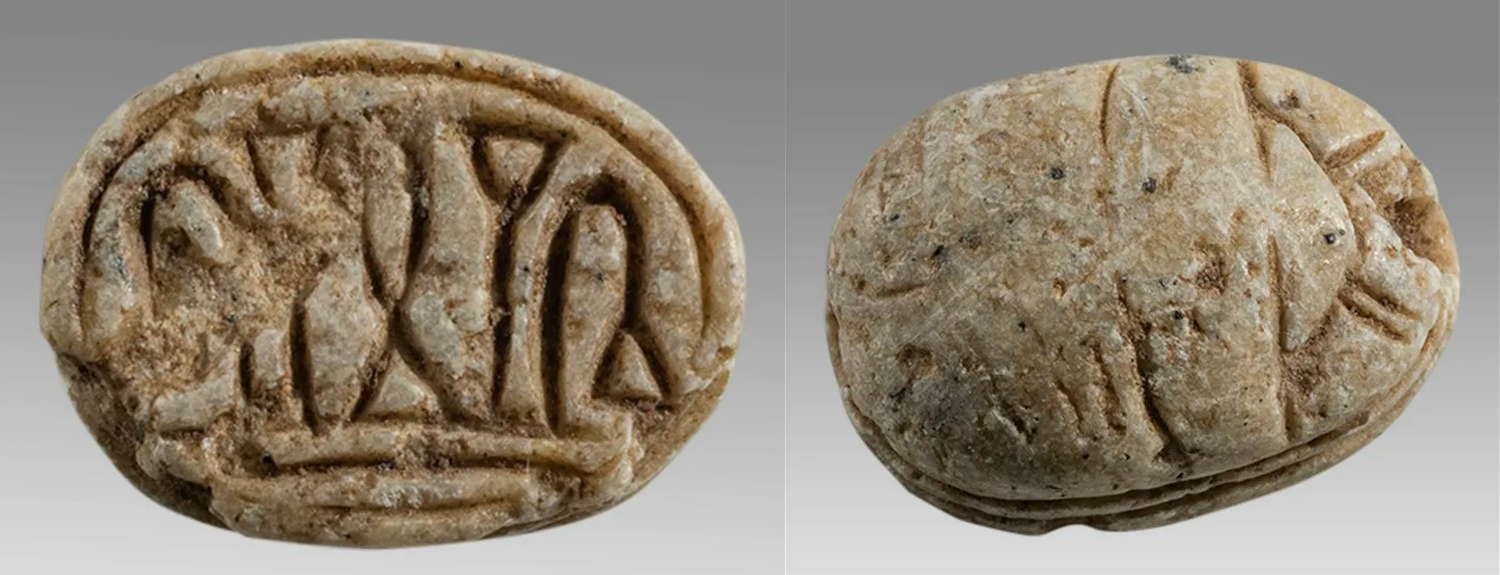
An ancient Egyptian – Canaanite white faience cylinder seal with decoration consisting of Egyptian hieroglyphs, Sa Ra cartouche of Tuthmosis III (Menkheperre) written as Rekheperre.
Exhibited and published: MINUSCULE MONUMENTS OF ANCIENT ART (May 1988) The New Jersey Museum of Archaeology at Drew University, Madison, NJ. Catalog by Alice Glock, fig. 133. This seal dates from the 13th to the 11th Century BC and measures 1,7 cm; c. 0.67 inches.v
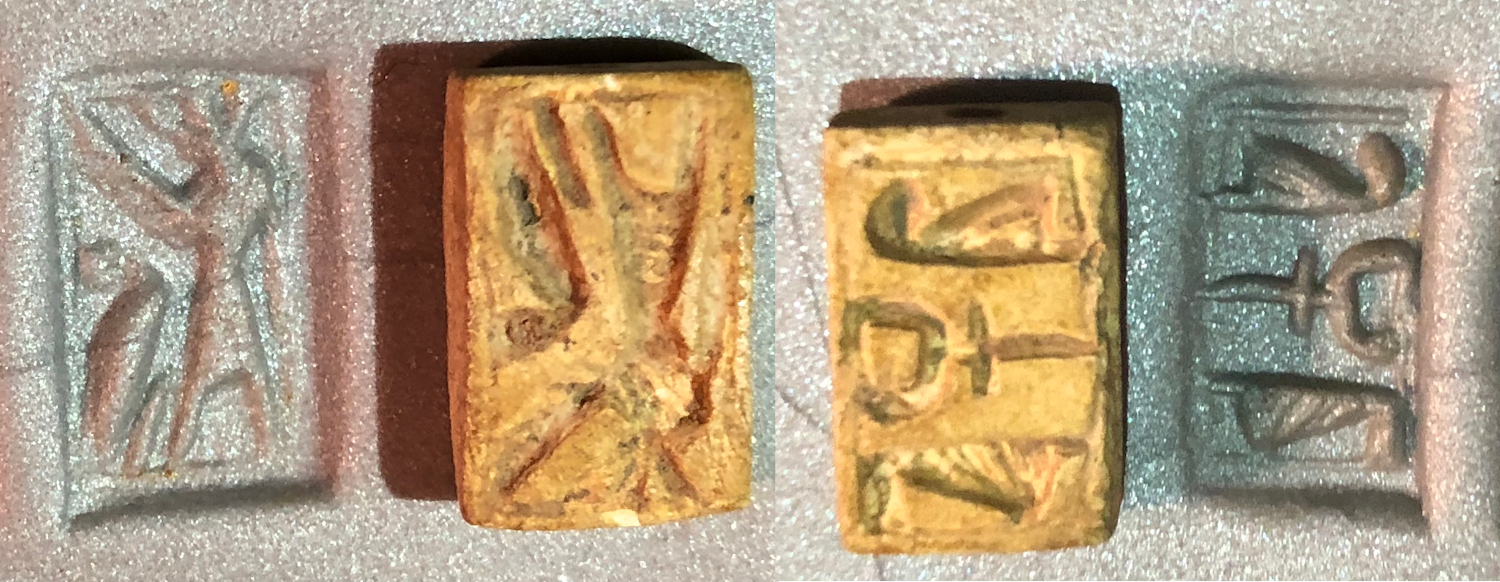
New Kingdom Period white stone plaque with deeply carved designs on both sides. On one side Osiris stands left before a bird. On the other side, the hieroglyphs read ma’At ma’At anX (Life to the eternal truth). This piece measures 16 x 6 mm and has a bidirectional hole through the center of the longer direction.
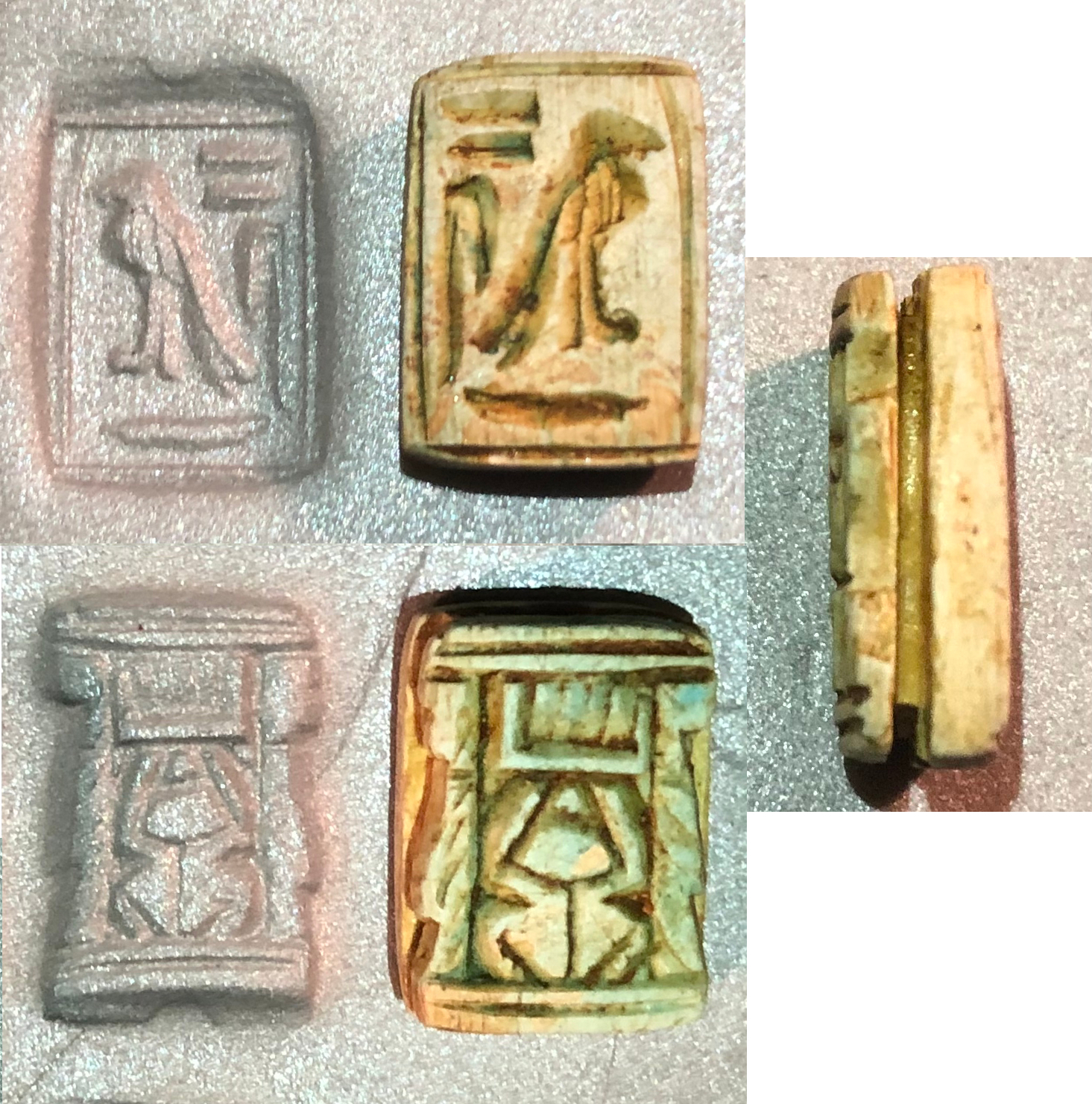
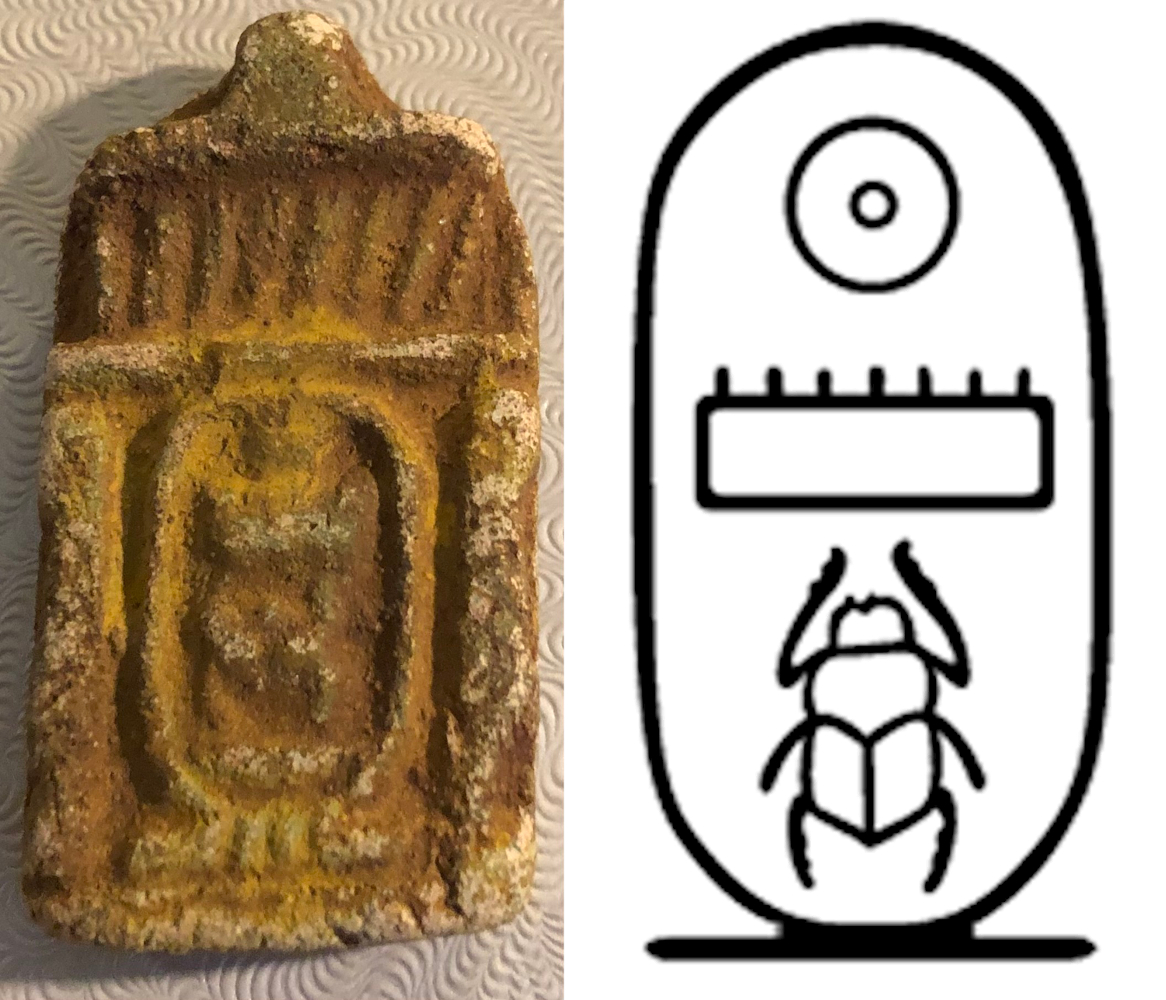
New Kingdom greenish white steatite plaque with designs engraved on both sides and a deep groove on all four sides. Dating from 1550-1050 BC, one side shows the falcon god Horus with an alphabetic reference that could be a personal name. The reverse side shows a hieroglyph of a scarab which means rebirth and above m’n, a reference to enduring rebirth or resurrection. Above is a hieroglyph the inferred meaning of which is a reference to Thutmose III, making these symbols a rough nomen cartouche. The “comb” hieroglyph means endure or enduring. There are also images of leaves or feathers on either side. This piece measures 17 x 12 x 6 mm and has a bidirectional drill hold through the long axis.
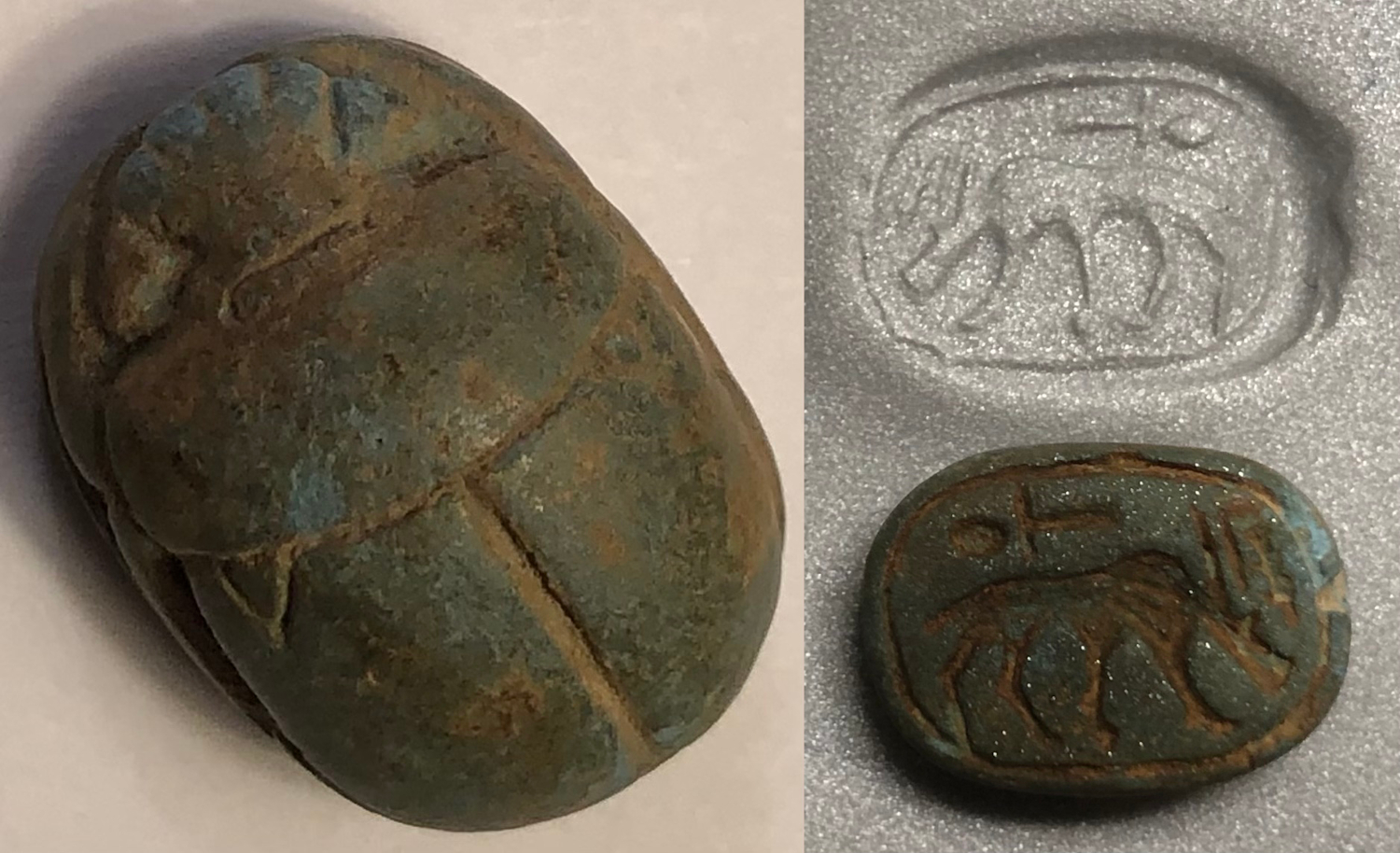
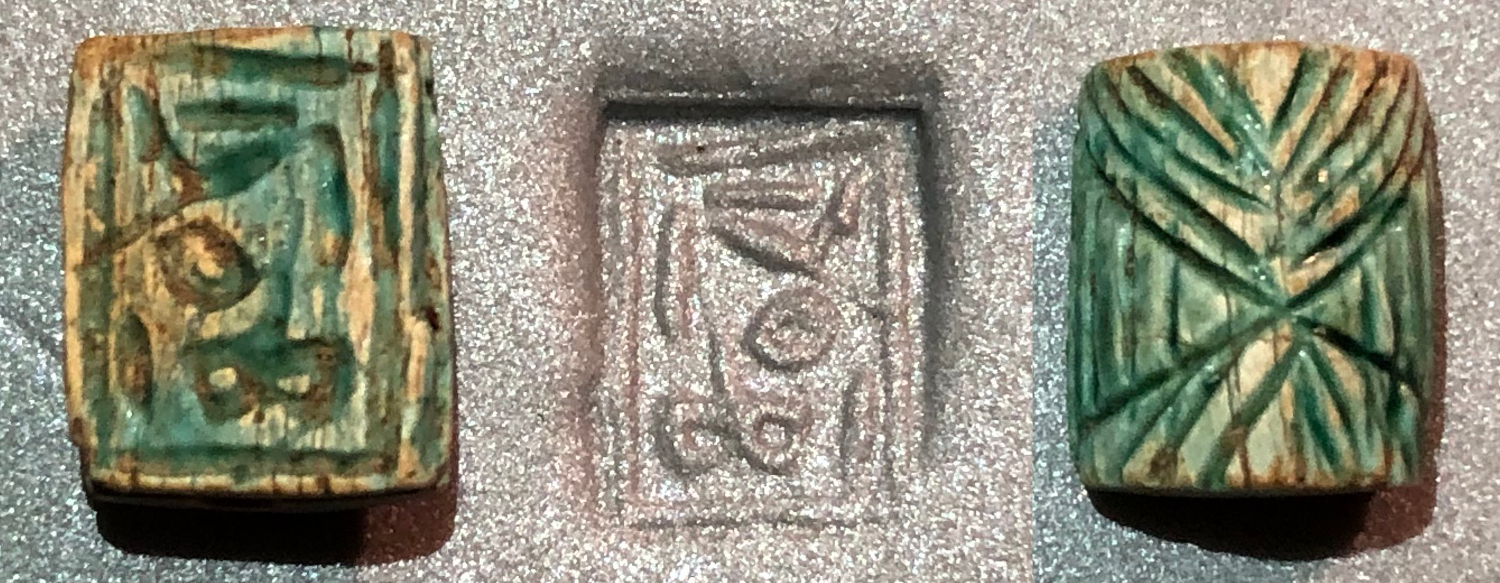
Ancient Egyptian green glazed steatite stamp seal from the New Kingdom Period, 1550-1050 BC. It is carved with stylized antelope jumping over some sort of obstacle, within a border on all four sides. This seal measures 11 x 9 x 6 mm and has a bidirectional drill hole through the long axis.
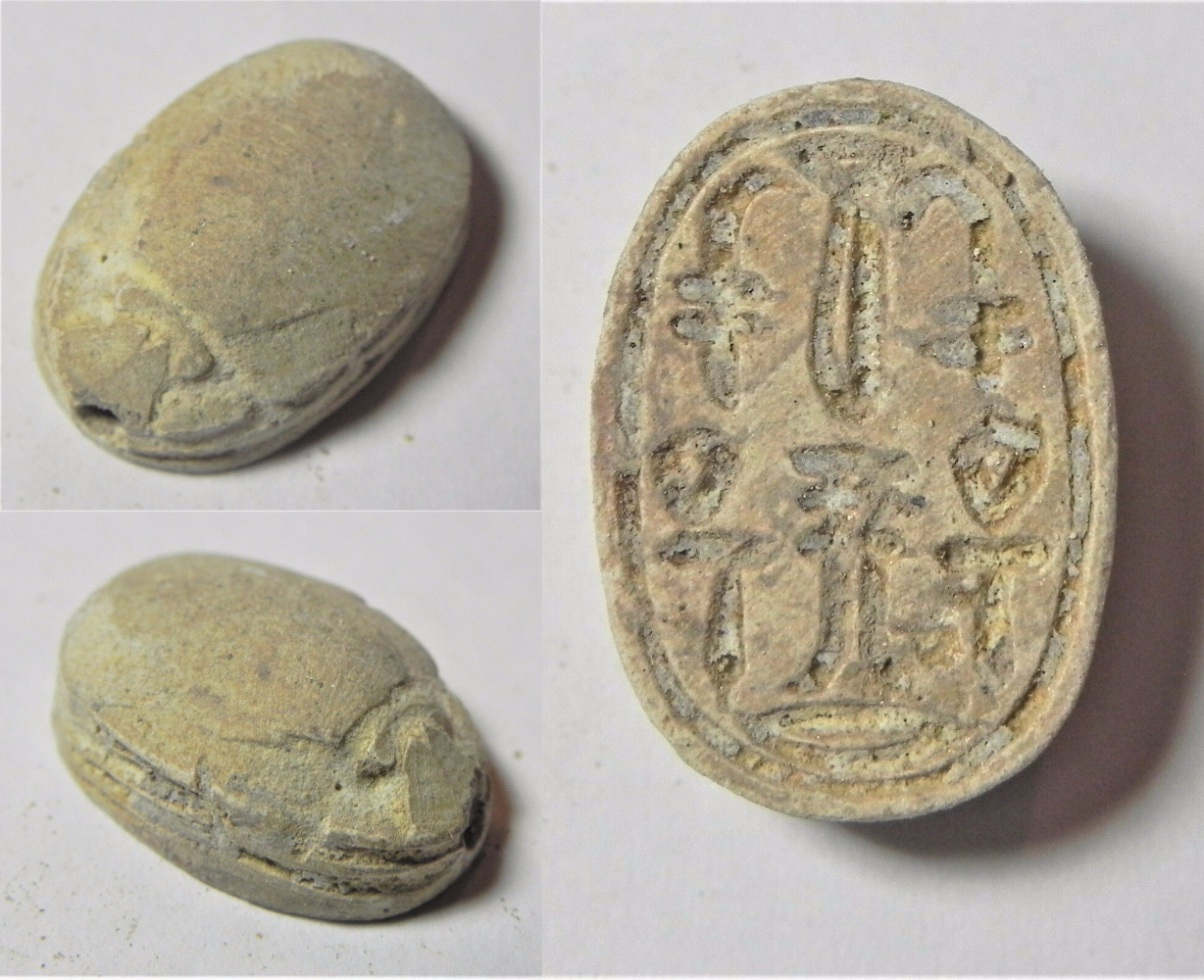
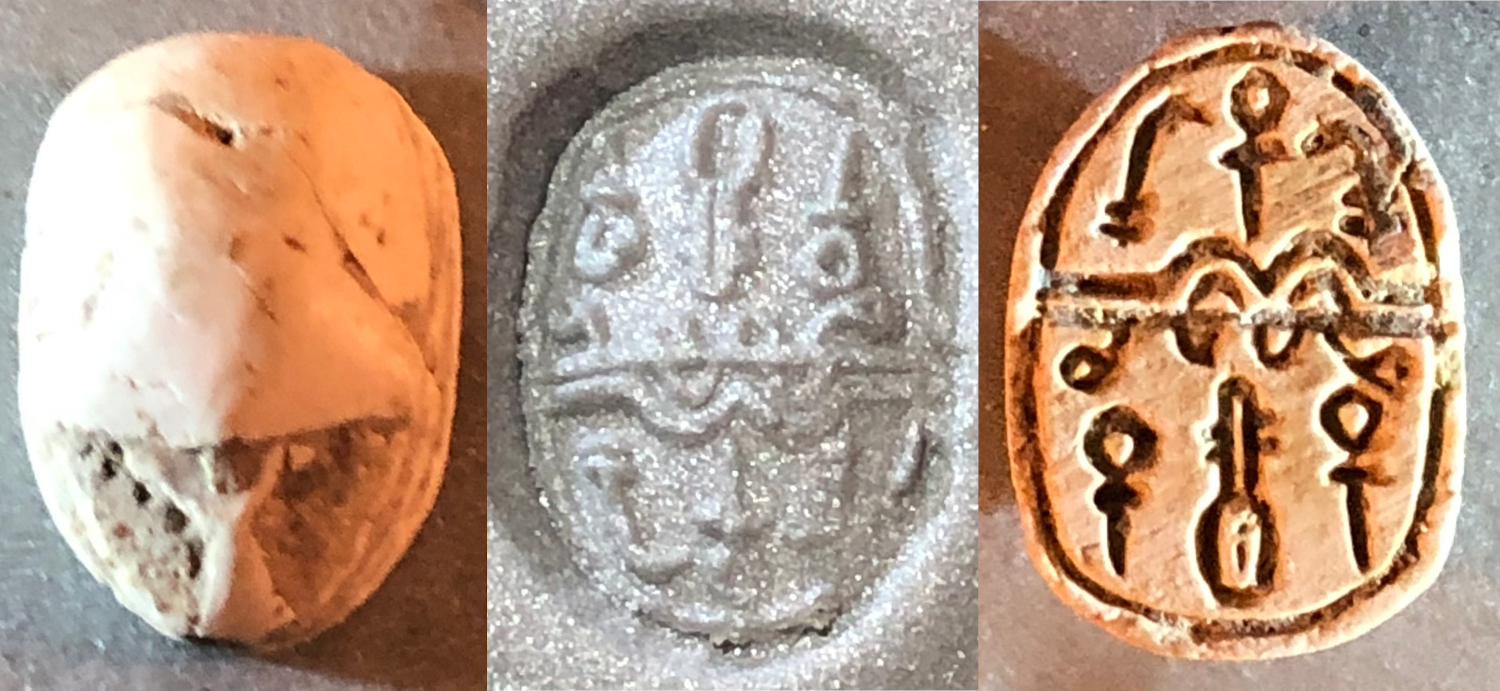
Ancient Egyptian white stone scarab from the New Kingdom Period, 1600-1100 BC. On the engraved face are a papyrus scroll on the upper section representing stability. On the lower section is a djed flanked by an ankh on either side. In combination these characters represent a wish for stability and eternal life for the Pharaoh. This seal has a bi-directional drill hole through the long axis and measures 17 x 13 x 8 mm.
Highly polished or glazed carved Egyptian green stone cylinder seal from the New Kingdom period, Circa 1400 BC. The impression of this seal depicts hard to interpret stylized images, perhaps of plants and animals. It has a bi-directional drill hole through the long axis for suspension and measures 15 mm in height and 10 mm in diameter.
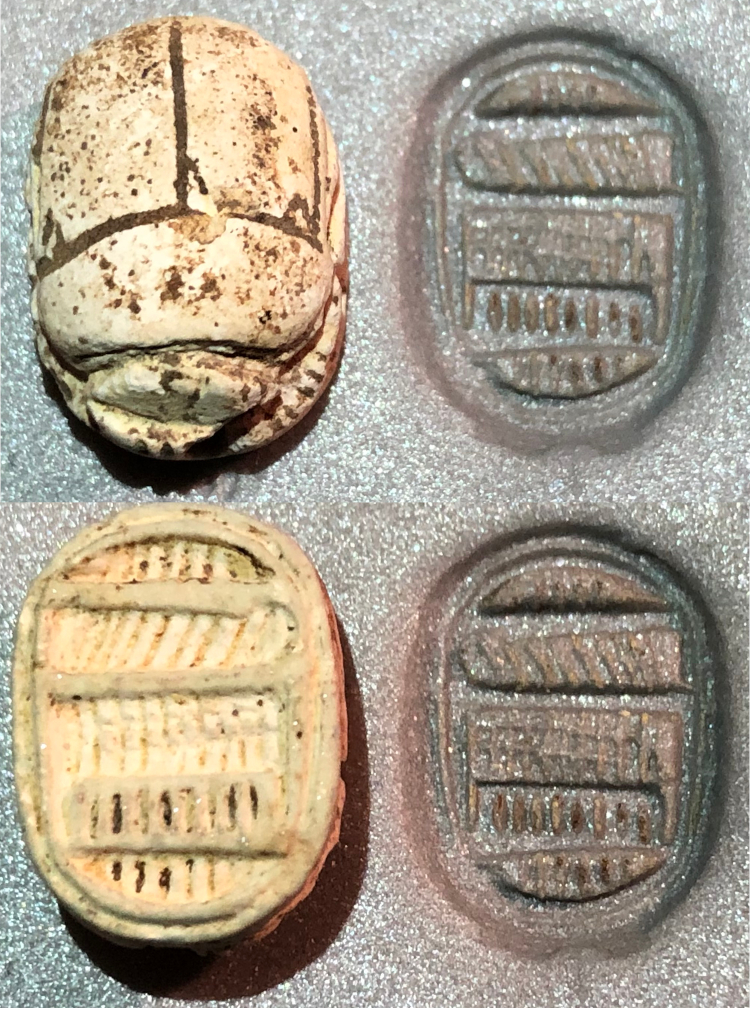
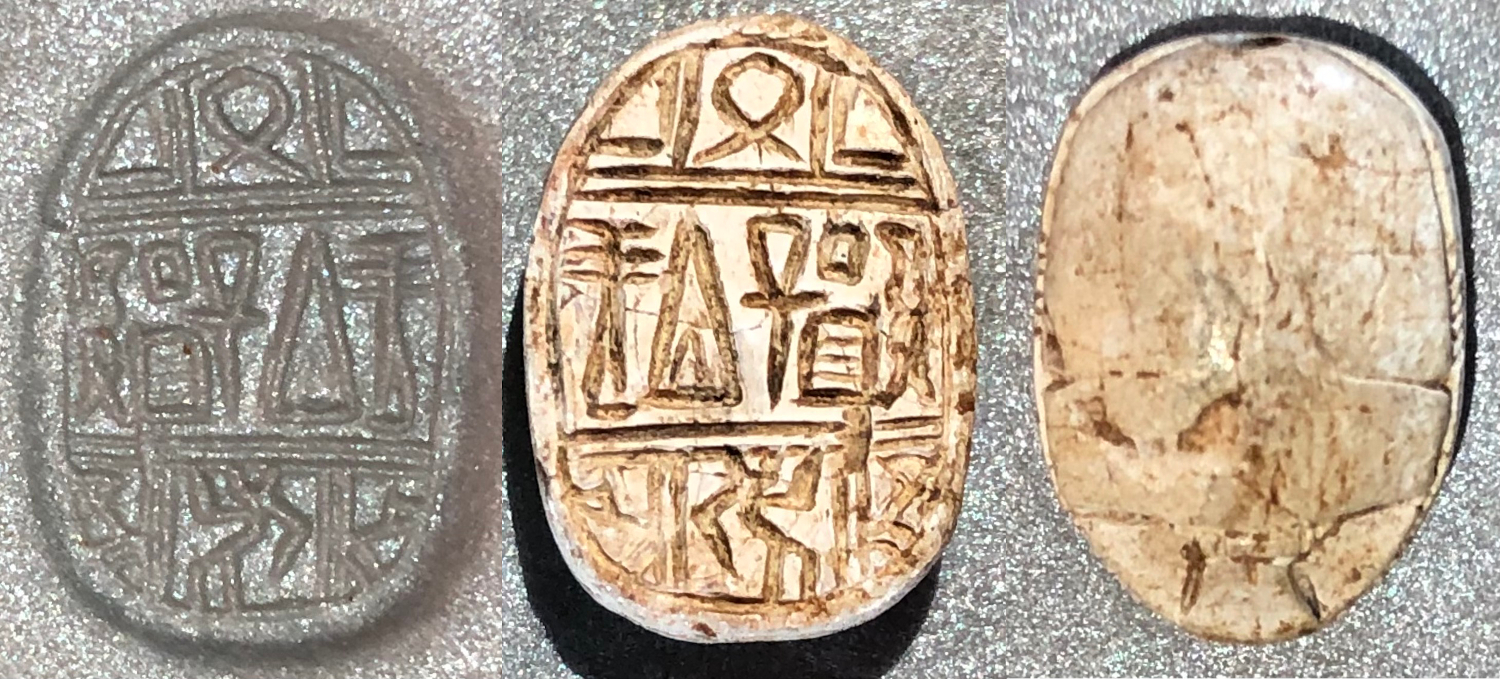
Ancient Egypt, white steatite stone scarab from the New Kingdom Period, 1550-1050 BC. The back is simply engraved with three lines of inscription: (-)s’ (-)/djed (-)anX(—)/Crown of Lower Egypt x2, suggesting “Protection /The backbone of Osiris is life /The eternal Pharaoh of Lower Egypt.” This scarab has a bidirectional piercing down the long axis for suspension and measures 16 mm x 11 mm x 7 mm.
Egyptian white stone scarab from the New Kingdom Period, 1550-1050 BC. The back is engraved with hieroglyphics that can be interpreted to mean, “The life of the eternal Pharaoh. The beautiful eternal life.” This scarab has a bi-directional drill hole through the long axis and measures 13 mm x 10 mm x 5 mm.
i Wegner, Josef, The Evolution of Ancient Egyptian Seals and Sealing Systems, Chapter 13, Part III – Egypt. Published online by Cambridge University Press: 24 April 2018
ii https://www.metmuseum.org/art/collection/search/567747
iiihttps://archaeologicalmuseum.jhu.edu/staff-projects/ancient-egyptian-amulets/scarabs/
iv Davis, Charlotte, Ancient Egyptian Scarabs: 10 Curated Facts to Know, The Collector, August, 2021.
v Essay by Dr. Senta German https://smarthistory.org/cylinder-seals/